UPSTREAM OIL AND GAS BUSINESS, REGIONAL ISSUES AND MULTIPLIER EFFECTS
Essential Knowledge for Public Relations Professionals
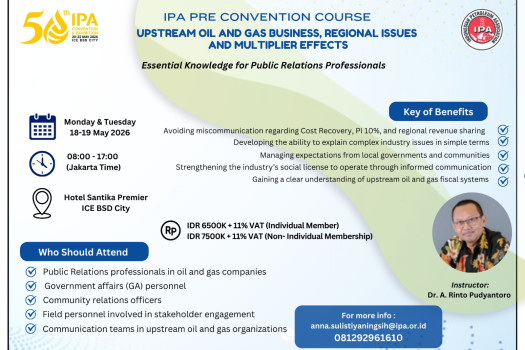
Instructor : Dr. A. Rinto Pudyantoro -
Dates : 18 -19 May 2026
Venue : Hotel Santika Premier – ICE BSD City
Time : 08:00 – 17:00 (Full day) – Jakarta Time
Cost : 6.500K + VAT 11% (IPA Individual Member)
7.500K + VAT 11% (Non-IPA Individual Member)
Includes : Digital course manual, 2x Coffee Break + Lunch.
We encourage Participants to apply as IPA Individual Member to get benefit for registration cost.
SUMMARY
The upstream oil and gas industry is a complex, capital-intensive, and high-risk sector where technical capability alone is not sufficient to ensure operational success. Public trust, stakeholder engagement, and effective communication are equally critical. Public relations professionals often serve as the frontline representatives of the industry, engaging with communities, local governments, and other stakeholders long before technical operations begin.
This training program is designed to equip public relations and field personnel with a clear understanding of the upstream oil and gas business, the Production Sharing Contract (PSC) system, and key regional fiscal issues. By understanding the business structure, fiscal mechanisms, and regional economic impacts, participants will be able to communicate more effectively, manage stakeholder expectations, and help maintain the industry's social license to operate.
COURSE DESCRIPTION AND OBJECTIVES
This executive training provides a practical and strategic understanding of the upstream oil and gas business, with a particular focus on fiscal frameworks, regional issues, and their broader economic impacts.
The course explains the principles behind Indonesia’s Production Sharing Contract (PSC) systems, including Cost Recovery and Gross Split, as well as the mechanisms of government revenue distribution such as DBH Migas, Participating Interest (PI) 10%, and PBB Migas. It also explores how upstream investment contributes to regional economic development through multiplier effects.
The objective of the course is to help participants:
- Understand the fundamental structure of the upstream oil and gas business.
- Interpret fiscal mechanisms within PSC systems.
- Recognize regional fiscal issues related to oil and gas operations.
- Communicate complex industry topics clearly and accurately to stakeholders.
LEARNING OUTCOMES:
By the end of the training, participants will be able to:
- Explain the key principles of Indonesia’s upstream oil and gas business model.
- Understand the differences between PSC Cost Recovery and PSC Gross Split systems.
- Interpret government revenue mechanisms such as DBH Migas, PBB Migas, and regional taxes.
- Understand the concept, risks, and challenges of Participating Interest (PI) 10%.
- Identify the economic multiplier effects of upstream oil and gas investment.
- Communicate fiscal and operational issues more effectively to communities, local governments, and other stakeholders.
AGENDA
Day 1 – Understanding PSC & National Fiscal Framework
PSC Cost Recovery vs Gross Split
- Background of Indonesia’s Production Sharing Contract system
- Key differences between Cost Recovery and Gross Split
- Fiscal risk allocation in PSC systems
- Impact of PSC mechanisms on government revenue
Fiscal Structure of the Upstream Industry
- Sources of government revenue from oil and gas
- Relationship between production, fiscal systems, and state income
Participating Interest (PI) 10%
- Policy objectives and regional participation
- Risks and obligations for regional-owned enterprises (BUMD)
- Carry vs Non-Carry mechanisms
Oil & Gas Revenue Sharing (DBH Migas)
- Calculation and distribution mechanisms
- Fiscal relationships between central and regional governments
Managing Regional Expectations
- Common misconceptions about oil and gas revenue
- Strategies for communicating fiscal realities to local stakeholders
Day 2 – Regional Fiscal Impact & Local Economic Linkages
Oil & Gas Land and Building Tax (PBB Migas)
- Legal basis and fiscal role
- Differences between exploration and production phases
Regional Taxes and Levies (PDRD)
- Regional tax structure related to upstream activities
- Opportunities and regulatory limitations for local governments
Economic Impact of Upstream Operations
- Multiplier effects of upstream investment
- Links between PSC activities and regional economic development
Strategic Communication for Fiscal Issues
- Communicating complex fiscal structures to stakeholders
- Building constructive dialogue with local governments
- Managing sensitive public narratives around oil and gas operations
WHO SHOULD ATTEND
This program is particularly suitable for:
- Public Relations professionals in oil and gas companies
- Government affairs (GA) personnel
- Community relations officers
- Field personnel involved in stakeholder engagement
- Communication teams in upstream oil and gas organizations
The training is designed to be practical and accessible for both junior and senior professionals.
WHY YOU SHOULD ATTEND
Participating in this training will help professionals strengthen their strategic communication capabilities in the upstream oil and gas sector.
Key benefits include:
- Gaining a clear understanding of upstream oil and gas fiscal systems
- Avoiding miscommunication regarding Cost Recovery, PI 10%, and regional revenue sharing
- Developing the ability to explain complex industry issues in simple terms
- Managing expectations from local governments and communities
- Strengthening the industry’s social license to operate through informed communication
Ultimately, this training enables public relations professionals to move beyond reactive communication and become strategic partners in supporting sustainable upstream oil and gas operations.
ABOUT THE INSTRUCTORS
Dr. A. Rinto Pudyantoro has over 31 years of experience in the upstream oil and gas industry. He began his career at VICO Indonesia for nearly 11 years, followed by 4 years at BP Indonesia, and then spent 16 years working at BP Migas and SKK Migas.
Until the end of May 2022, Dr. Rinto Pudyantoro served as Head of the Program and Communication Division at SKK Migas. Previously, he served as Head of the SKK Migas Representative Office for Papua and Maluku. He also handled Oil and Gas Taxation at SKK Migas and was involved in Revenue Accounting and State Budget (APBN) management.
Rinto has authored several books on upstream oil and gas business, including:
- A to Z Bisnis Hulu Migas
- Dialog Tanya Jawab Migas
- Projek Hulu Migas – PetroEkonomi
- Bisnis Migas – Menakar Persoalan
- Multiplier Effect 1st Kick
More than 30 opinion articles on oil and gas and upstream business issues have been published in various print and online media
HOW TO REGISTER :
- Please contact to Anna Sulistiyaningsih : anna.sulistiyaningsih@ipa.or.id or WA : +62 81292961610
- Complete the registration form : https://forms.gle/WVaDDgGQmewMTUE37
- Registration will be closed on 12 May 2026